"Bashert" by Conrad Singer            Chapter 12 Ebro and Retreat

twelve

EBRO AND RETREAT


    When the Battle of Teruel was over, my detachment was sent to Almansa. We waited many weeks for new guns to be delivered. Out of the blue, we heard that the Phalange had broken through from Aragon and were advancing. However, the spirit of our artillerymen was great. The majority were Spanish and belonged to the Pasionara battery.

    In order to avoid being cut off, we left hurriedly for Catalonia. Somewhere near Vinaroz, German aircraft attacked the train. They strafed the whole length of the train with machine gun fire. The train was brought to a halt, in the darkness and all the troops ran from the wagons.  As the plane circled, I ducked behind a stone wall. The track of luminous tracer bullets was smashing in to the ground close by. Miraculously, nobody was hit. As luck would have it, my jump over the wall had landed me in a heap of farmyard manure.

    We moved to a camp in Reus, near the banks of the River Ebro. We were privileged with a visit from the famous  “La Pasionara” herself, who gave us a rousing speech and received in turn a most enthusiastic response from the troops.

    A few days later, after the battery had taken up position, the great Battle of the Ebro had begun. The crossing of the river was a great victory for our Republican Army. In two days we had conquered forty square kilometres of territory. But, as always, we were unable to take advantage of the achievement and the advance began to wither through lack of air support. Throughout the battle, there had never been any defence for our troops against enemy aircraft.

    By this time, autumn ‘39, The League of Nations was working for the withdrawal of the International Brigade, together with the German and Italian forces, who were supporting Franco.  All the international volunteers retreated from the front at Ebro and joined their comrades who had withdrawn from the other active fronts. There was no heart in our troops now. It seemed totally pointless to continue fighting in the face of overwhelming odds. It was now evident that the cause was lost. And the retreat of what remained of our army began.

    I was given a pass at camp to allow me to travel to Barcelona. As I walked along the main street, in the city centre, I was amazed to come across a bunch of seamen, who were my old pals from the Verbormilia. On my return, I was delighted to be able to tell everybody at the camp about this marvellous encounter. But, when I asked for another pass, to enable me to return to the city, the Commissars, mostly Yugoslav, protested that all these sailor friends of mine were fascists and that I should have no further contact with them. I went back, all the same and was immediately arrested.  My interrogators maintained, to the end, their mistrust of volunteers, who had not belonged to the Communist Party.

    Once again, my good fortune held up. A Romanian from Braila, my city of birth, was in the camp and he knew my family. As a longstanding member of the Party who was well thought of, he stood up for me. No disciplinary action was taken.

    Now that the Phalange was very close to Barcelona, most of the population were living in fear of the inevitable repression and vengeance, which would be visited on them by the Franco military. Many of the people who had sympathised with the Republic were preparing for an exodus to France and the unknown. Soon, roads were thronged with thousands of civilian refugees, some with their household goods piled high on horse-drawn carts. It was a terrible and heartbreaking sight for me as I joined them with my fellow ex-fighters. During this retreat from Barcelona to San Pedro Pescador we were more a group of refugees than a fighting force.

After a trek of some sixty to seventy kilometres taking 10 hours and with a break every 4 kms or so, we arrived late in the night, dropping with fatigue, at the village of San Pedro Pescador. The following day, the famous French communist leader, Andre Marty, came 
to the village square. He gave us a most fantastic sermon, full of the most abject insults. “Cowards”. “Rabbits”.  “Rabble”. These were just a few of the offensive terms he fired at us, ignoring the obvious. By now all our men had been disarmed and there was little else that could have been done.

   Eventually the order was given to embark a train, which was to take us out of Spain via Bordeaux, France, en-route for Mexico. We were all happy that the war had come to an end, but sad at heart. We knew that without us the 

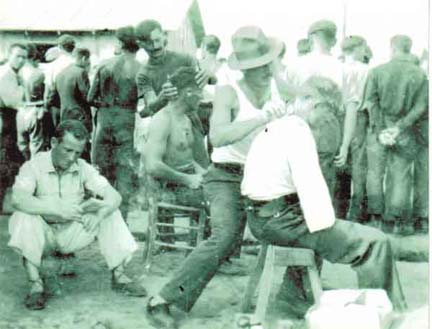
Internment Camp de Gurs, Romanian section, Pyranees, Age 27 (1939) - I'm seated left waiting for a haircut

Republican Front would collapse. Then the order to embark was countermanded because we were told that we were not allowed to cross into France and that we would be interned at Camp de Gurs in the Pyrannean mountains.


    In fact we moved to Argeles, an internment camp. The conditions on our night of arriva were appalling. There was no food and we were exhausted from the march. There was a cold wind blowing down from the Pyrenees, called the “Tramontain”, which was freezing us to the bone. To keep ourselves alive, we took to dancing until we dropped exhausted on the sand and slept. During those first three or four days, we only survived through good fortune and not from any help from the French authorities.

    Life in the camp improved a lot as the foreign press began to report the atrocious conditions that the desperate refugees were facing. A recruiting hut for the French Foreign Legion had been set up. My two Romanian comrades and I decided that we had spent far too long languishing in this internment camp and that we should offer ourselves as new recruits.

    We were sent to the barracks of the Senegalese at Perpignan, where the Legion had its main recruitment offices for that area. I was rejected, due to my poor eyesight. We found ourselves in the Camp de Arras. The conditions here were equally absolutely atrocious. The transit depot was now crammed to bursting point with about six thousand Spaniards. There was no room on the floor to stretch out to sleep. The food ration consisted of one sardine per day on a wedge of bread; sometimes the men at the end of the queue were left with nothing.


   On the second day, the inmates decided to hold a silent march. Alarm bells were rung and the Senegalese troops were brought out in combat gear, with orders to charge and disperse us. However, the soldiers were often sympathetic to the republican cause. To the great surprise of the French Police, they refused to charge, merely watching and allowing the demonstration to disband.

    We were eventually moved to a couple of other camps. The second had much better living conditions .It was now the autumn of 1939 and the major war in Europe had begun. Duty, born of idealism, required me to try again to volunteer for the French Army.

Home      Contents

Previous       Next